Product Description
The TP53 Knockout Cell Line (HEK293) is generated using CRISPR/Cas9-mediated genome editing to achieve specific disruption of the TP53 (Tumor Protein p53) gene in the HEK293 human embryonic kidney cell line. The knockout is validated by Sanger sequencing to confirm genomic alteration.
About the Target Gene
TP53 (Gene ID: 7157), located on chromosome 17p13.1, encodes the p53 tumor suppressor protein — one of the most extensively studied genes in cancer biology. p53 functions as a transcriptional regulator that responds to diverse cellular stresses, including DNA damage, oncogene activation, and hypoxia, by activating downstream target genes that induce cell cycle arrest, apoptosis, senescence, or DNA repair. Mutations in TP53 are found in approximately 50% of all human cancers, making it the most frequently mutated gene in malignancy. Germline mutations are associated with Li-Fraumeni syndrome, a hereditary cancer predisposition disorder.
Key Applications
- p53 Signaling Pathway Research — Investigate the role of p53 in cell cycle regulation, apoptosis, and DNA damage response using a clean genetic knockout background
- Drug Screening & Validation — Serve as a p53-null control to evaluate the on-target activity of MDM2 inhibitors (e.g., Nutlin-3), p53 reactivators
- Gene Function Studies — Compare phenotypic differences between TP53 knockout and wild-type HEK293 cells to elucidate p53-dependent and p53-independent regulatory mechanisms
- Synthetic Lethality Screens — Identify therapeutic targets that are selectively essential in TP53-deficient backgrounds
- Tumor Suppressor Biology — Model the loss of p53 function to study tumor initiation, progression, and metabolic reprogramming
Research Areas
Cell Cycle Regulation · Apoptosis · DNA Damage Response · Tumor Suppressor Pathways · Cancer Biology · Drug Resistance Mechanisms
Origin and General Characteristics
Gene ID: 7157
Gene Name: TP53
Cell Name: TP53 Knockout cell line (HEK293)
Homo sapiens: Human
Morphology: Epithelial-like
Growth: Adherent
Culture Conditions
Complete Growth Medium: 90%DMEM+10% FBS
Freezing medium: 90% complete medium + 10% DMSO
Methods for Passages: 0.05% trypsin-EDTA
Temperature: 37°C
CO2 Conc.: 5%
Knockout Strategy
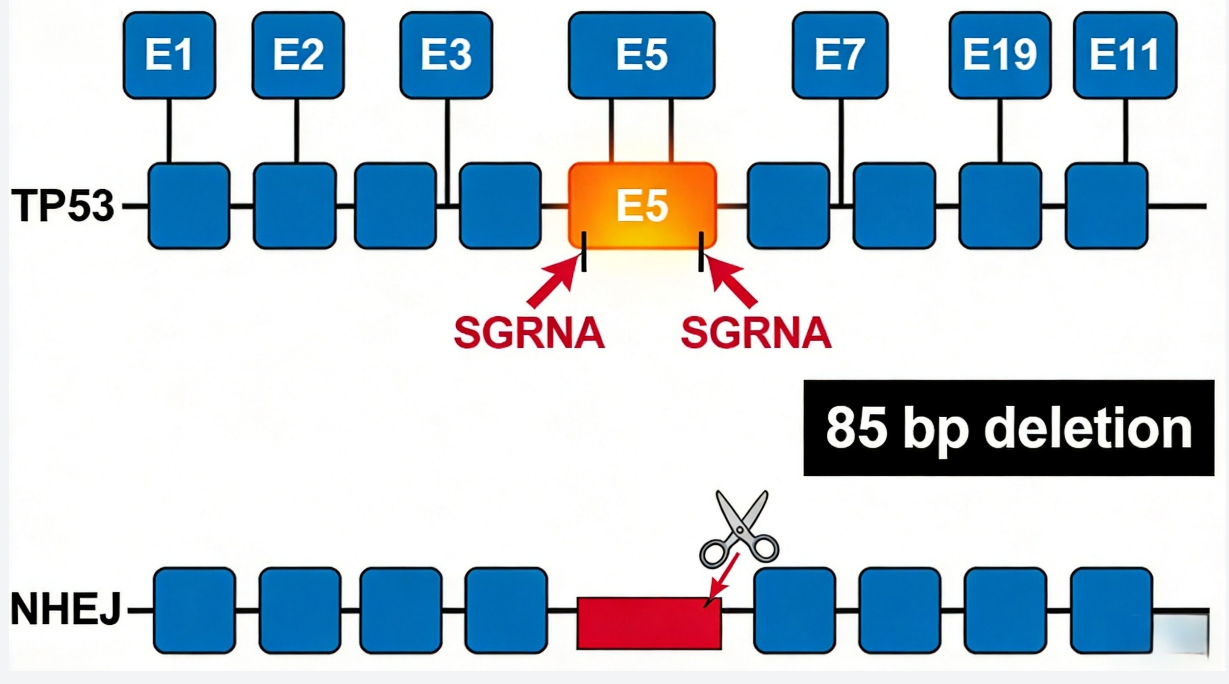
The TP53 knockout was generated using CRISPR/Cas9-mediated targeted disruption of exon 5 (E5) of the TP53 gene. Dual sgRNAs were designed to flank a defined region within exon 5, resulting in a precise 85 bp deletion upon Cas9 cleavage and non-homologous end joining (NHEJ)-mediated repair. The deleted sequence is indicated in red in the schematic below.
Exon 5 was selected as the knockout target because it encodes a critical region within the DNA-binding domain of p53 (residues ~135-185). Deletion of this 85 bp segment causes a frameshift and premature termination, resulting in a truncated, non-functional p53 protein. This strategy ensures complete loss of p53 tumor suppressor activity across all known TP53 transcript variants, as exon 5 is constitutively present in all isoforms.
Recommendations for Handling Cryopreserved Cells
Upon Receipt
-
The cell vial is shipped on dry ice. Upon delivery, verify that the vial remains completely frozen. If any thawing is observed, photograph the vial before proceeding with culture or storage — this documentation may be required for replacement claims.
-
If not culturing immediately, transfer the cryovial to liquid nitrogen (-196°C) for long-term storage without delay. Short-term storage at -80°C is acceptable for up to one week, but viability may decline over time. Do not store at -20°C.
Cell Thawing & Revival
-
Pre-warm the complete culture medium (90% DMEM + 10% FBS) to 37°C before starting. Prepare a 37°C water bath with clean water containing an antimicrobial agent.
-
Rapidly thaw the cryovial by gentle agitation in the 37°C water bath for 45–90 seconds. Monitor closely — thaw just until a small ice crystal remains. Do not submerge the cap. Immediately remove the vial from the water bath once thawed.
-
Transfer the cryovial to a sterile biosafety cabinet. Wipe the exterior thoroughly with 70% ethanol before opening.
-
Carefully open the vial and transfer the cell suspension into a 15 mL centrifuge tube containing 9 mL of pre-warmed complete medium. To maximize cell recovery, rinse the cryovial with 1 mL of complete medium and add the rinse to the same tube. Gently resuspend the cells.
-
Centrifuge at 300 × g for 3 minutes at room temperature. Carefully aspirate and discard the supernatant without disturbing the cell pellet.
-
Gently resuspend the pellet in 5–10 mL of fresh pre-warmed complete medium. Transfer the cell suspension into a T25 culture flask or a 60-mm dish.
-
Incubate at 37°C in a humidified atmosphere with 5% CO₂. Monitor cell attachment and morphology the following day. Replace with fresh medium once cells have adhered properly (typically 16–24 hours after seeding).
Shipment
Ships within 2-4 weeks in US
Frequently Asked Questions
Q: How is the TP53 knockout validated?
The knockout is confirmed by Sanger sequencing of the target region to verify the 85 bp deletion in exon 5.
Q: What is the recommended culture medium?
A: 90% DMEM + 10% FBS. No additional antibiotics are required, though penicillin/streptomycin (1%) may be added at the user's discretion.
Q: What is the recommended passage ratio?
A: 1:5 split ratio, every 2 days at approximately 80–90% confluence. Avoid over-confluence, as it may affect cell morphology and experimental reproducibility.
Q: What if the cells show poor viability after revival?
A: If cell viability is below 70% within 48 hours of thawing, please document the condition with photographs and contact our technical support. Replacement may be provided upon review. Common causes include delayed transfer to liquid nitrogen upon receipt or deviations from the recommended thawing protocol.
Q: Can these cells be used for in vivo studies?
A: This product is intended for in vitro research use only. It has not been tested or approved for use in humans or animals, including clinical, therapeutic, or diagnostic applications.
Q: What is the shipping timeline?
A: Cells are shipped on dry ice within 2–4 weeks of order confirmation. Rush orders may be available upon request.
Q: Is a wild-type control cell line included?
A: Yes. Every order includes one wild-type HEK293 isogenic control vial at no additional cost. Both the knockout and wild-type vials are shipped together on dry ice, so you have a matched reference ready for side-by-side comparison from day one.


